
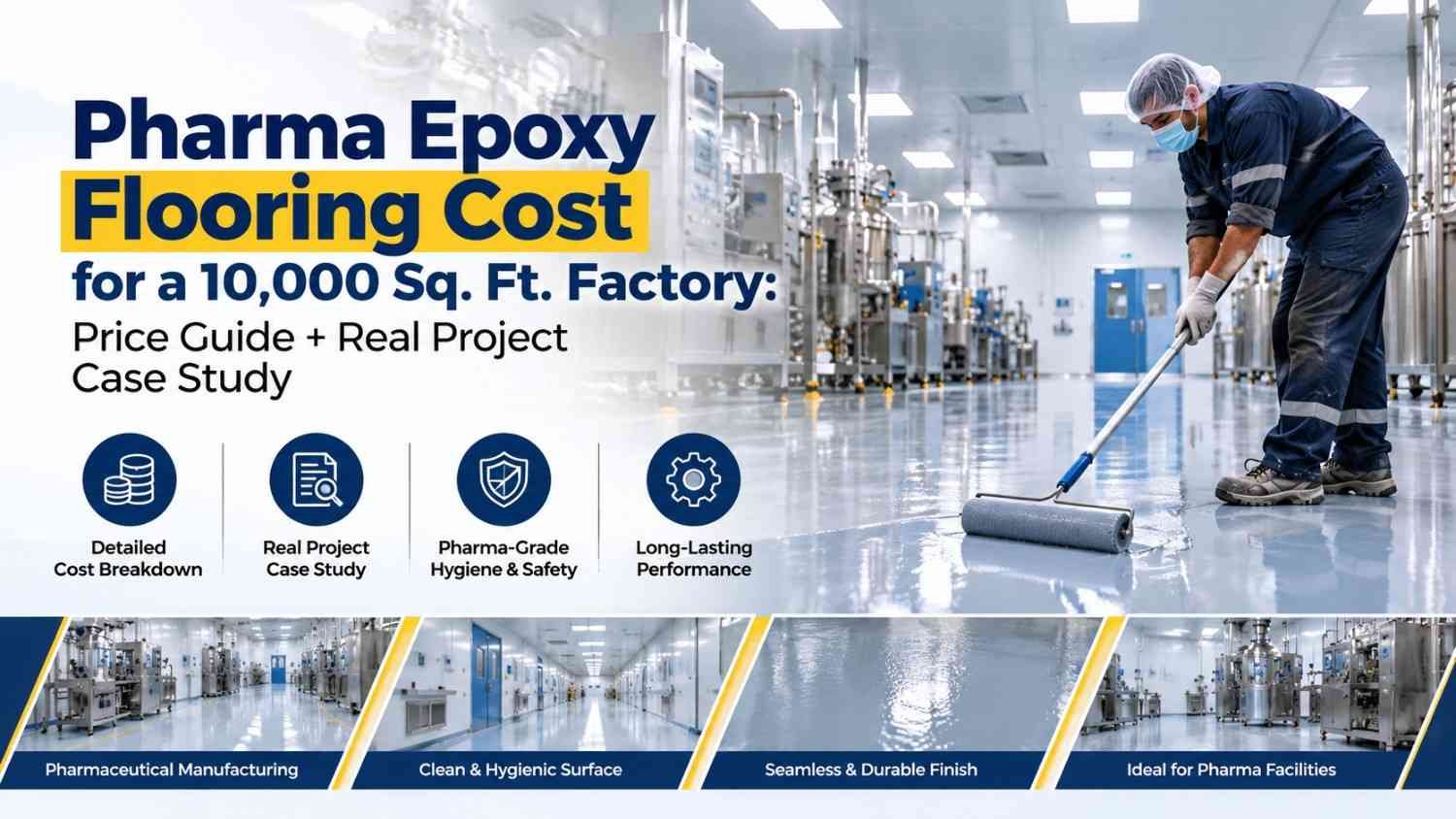
Quick answer: Pharma epoxy flooring for a 10,000 sq. ft. factory typically costs somewhere between ₹5 lakh and ₹20 lakh or more, depending on the system, thickness, condition of the existing floor and the detailing required. That works out to roughly ₹50 to ₹200+ per sq. ft. The exact figure can only be confirmed after a site inspection. Mann Enterprise, a Kathwada-based epoxy flooring specialist with over 10 years of experience, recently completed a 10,000 sq. ft. pharmaceutical plant floor, and this guide uses that project to explain what actually drives the price.
If you manage a pharma plant in Ahmedabad, you have probably asked a contractor “what will it cost?” and received an answer that is either vague or suspiciously low. This guide gives you a realistic starting point, shows you what goes into the number, and walks through a real project so you know what you are paying for.
Note: the price ranges below are indicative market ranges, not a fixed quotation. Floor condition, system and site conditions change the final cost.
Why pharma flooring matters more than ordinary industrial flooring
In a normal warehouse, a worn floor is an inconvenience. In a pharmaceutical facility, the floor is part of the operating environment.
Pharma spaces generally need floors that are:
- Seamless: no joints or gaps where dust, residue or moisture can collect
- Easy to clean and sanitise: smooth, non-porous surfaces that handle regular cleaning
- Durable: able to handle trolleys, equipment movement and cleaning chemicals without breaking down
- Dust-free: bare or worn concrete can dust, which is a problem in controlled areas
- Low maintenance: fewer repairs mean less disruption to production
Pharmaceutical plants also work under GMP expectations, such as India’s revised Schedule M, which place importance on clean, maintainable surfaces. An epoxy floor does not make a plant compliant by itself, but a well-installed seamless floor supports the cleanliness and maintenance requirements your quality team has to meet. Always confirm specific requirements with your own QA and regulatory teams.
How much does pharma epoxy flooring cost for 10,000 sq. ft.?
Here is a realistic way to think about it. Costs are shown per sq. ft. and as a total for a 10,000 sq. ft. area.
| System / scope | Indicative rate (₹ per sq. ft.) | Approx. total for 10,000 sq. ft. | Typical use |
|---|---|---|---|
| Thin epoxy coating | ₹30 to ₹60 | ₹3 to ₹6 lakh | Light-duty, non-critical areas |
| Standard self-leveling epoxy (1 to 2 mm) | ₹50 to ₹110 | ₹5 to ₹11 lakh | General industrial and packing areas |
| Pharma-grade self-leveling epoxy (2 to 3 mm, full prep, detailing) | ₹100 to ₹200 | ₹10 to ₹20 lakh | Production corridors, process and cleanroom-type areas |
| Specialised systems (ESD, high chemical resistance, special detailing) | ₹150 to ₹250+ | ₹15 to ₹25 lakh+ | Specific high-spec zones |
These ranges are drawn from publicly listed Indian market prices and published guides, which vary widely by city, material brand, thickness and scope. Use them as a starting budget only. A very low quote usually means thin coverage, minimal preparation or lower-grade materials, which is exactly where floors fail.
A simple way to estimate your budget
Total cost = (Area × rate per sq. ft.) + extra preparation and repair + detailing and extras
For example, with 10,000 sq. ft. at ₹120 per sq. ft., the base cost is ₹12 lakh. If the existing floor needs heavy repair or special wall-edge detailing, add those on top. This is why a site visit comes before a final price.
What decides the cost of pharma epoxy flooring?
- Condition of the existing floor: damaged, stained or uneven concrete needs more repair and preparation time.
- Type of system: self-leveling, mortar, ESD and specialty systems are priced differently.
- Thickness: a 3 mm system uses more material than a 1 mm coat.
- Surface preparation method: grinding or shot blasting, crack repair and moisture treatment add labour but protect the result.
- Moisture in the slab: damp concrete may need treatment before any coating.
- Detailing: edges, corners, wall junctions and door areas take extra time and materials.
- Working conditions: phased work, night shifts or limited access to run around production can affect cost.
- Material quality: better-grade resins and primers cost more but perform longer.
- Timeline: urgent or compressed schedules may add cost.
Case study: 10,000 sq. ft. pharmaceutical plant flooring by Mann Enterprise
We recently completed epoxy flooring across a 10,000 sq. ft. pharmaceutical plant. Here is how the project went, step by step.
| Project snapshot | Details |
|---|---|
| Client type | Pharmaceutical manufacturing plant |
| Area | 10,000 sq. ft. |
| Scope | Surface preparation, primer and epoxy flooring system |
| Location | Ahmedabad |
| System used | depends area |
| Duration | Depends workds |
| Contractor | Mann Enterprise |
The starting point
The existing floor was ordinary, worn concrete with visible stains and surface wear. In a pharma environment, that kind of surface is hard to keep clean and can break down further under regular use.
Step 1: Surface inspection
Before anything was applied, our team inspected the base. The condition of the base decides how the finished floor will perform, so we checked for weak areas, damage and contamination.
Step 2: Cleaning and preparation
The surface was thoroughly cleaned and prepared so the primer and epoxy could bond properly. This is the stage most contractors rush, and it is the stage that matters most.
Step 3: Repair of weak areas
Cracks, damaged spots and weak sections were repaired so the final surface would be uniform and stable.
Step 4: Primer and epoxy application
A primer was applied for adhesion, followed by the epoxy system, with attention to even coverage and a smooth finish across the whole area.
The result
The plant now has a seamless, glossy epoxy surface that is clean, durable and easy to maintain, replacing the old worn concrete. The finished floor runs continuously through corridors and work areas without visible joints on the main surface.
What the client gained:
- A hygienic, easy-to-clean surface
- A durable floor built for daily operations
- Lower maintenance effort
- A professional appearance across the facility
How to plan a pharma epoxy flooring project (step-by-step guide)
- Define your requirements. List the areas, how each is used, what equipment moves across them, which chemicals are present, and your cleaning routine.
- Involve your QA and engineering teams early. Agree on surface and maintenance expectations before choosing a system.
- Book a site inspection. A reliable contractor will check the slab, moisture and existing damage before quoting.
- Choose the right system. Self-leveling epoxy is common for pharma areas, while specialised zones may need different systems.
- Plan the schedule around production. Large floors can often be done in phases to limit downtime.
- Compare written quotes properly. Check area, system, thickness, preparation method, timeline and warranty on every quote.
- Allow proper curing. Do not open the floor to traffic or equipment before it has cured.
- Set up a maintenance routine. Agree cleaning methods and products with your contractor so the floor lasts.
Common mistakes that increase cost later
- Choosing the cheapest quote without asking about surface preparation
- Applying epoxy over damp or poorly prepared concrete
- Using one system for every area regardless of use
- Skipping repair work to save time
- Opening the floor too early
- Not planning maintenance
How to control cost without compromising quality
- Get the site inspected early, so there are no surprises
- Phase the work to match your production schedule
- Match the system to each area instead of over-specifying everywhere
- Invest in preparation, because it prevents expensive redo work
- Bundle related work, such as waterproofing or repairs, into one project plan
Frequently asked questions
How much does pharma epoxy flooring cost for a 10,000 sq. ft. factory? Typically between ₹5 lakh and ₹20 lakh or more, depending on the system, thickness, floor condition and detailing. The final price needs a site inspection.
What is the cost per sq. ft. of epoxy flooring for a pharmaceutical plant? Roughly ₹50 to ₹200+ per sq. ft. in India, with pharma-grade self-leveling systems generally sitting in the upper part of the range.
Which epoxy flooring is best for pharma plants? Seamless self-leveling epoxy is widely used because it is smooth, easy to clean and durable. The right choice depends on the area, traffic and chemical exposure.
How long does it take to install epoxy flooring in 10,000 sq. ft.? It depends on floor condition, preparation needs, number of coats and phasing. Many projects of this size take roughly one to two weeks including curing, but your contractor should confirm after inspection.
Is epoxy flooring suitable for cleanrooms and pharma areas? Seamless epoxy floors are commonly used in pharmaceutical and cleanroom-type environments because they are non-porous and easy to clean. Confirm your exact specification with your QA team.
How long does pharma epoxy flooring last? With correct preparation, installation and maintenance, epoxy floors can last many years. Traffic, chemicals and cleaning practices affect lifespan.
Does Mann Enterprise provide pharma epoxy flooring in Ahmedabad? Yes. Mann Enterprise, based in Kathwada, Ahmedabad, provides epoxy flooring for pharmaceutical, food, warehouse, automobile and other industrial facilities, with free site inspections.
Can the work be done without stopping production? Often yes, by phasing the work area by area. This is planned during the site visit.
Get a free site visit and accurate quote
Every plant is different, so the most reliable way to know your cost is to have your floor inspected. Mann Enterprise offers a free site visit across Ahmedabad and a clear written quote.
Mann Enterprise Swetayan Industrial Park, Kathwada, Ahmedabad, Gujarat 382430 Phone: +91-8155986415 Website: mannenterprise.com
Learn more about our industrial epoxy flooring services in Ahmedabad and read our epoxy flooring process guide.