

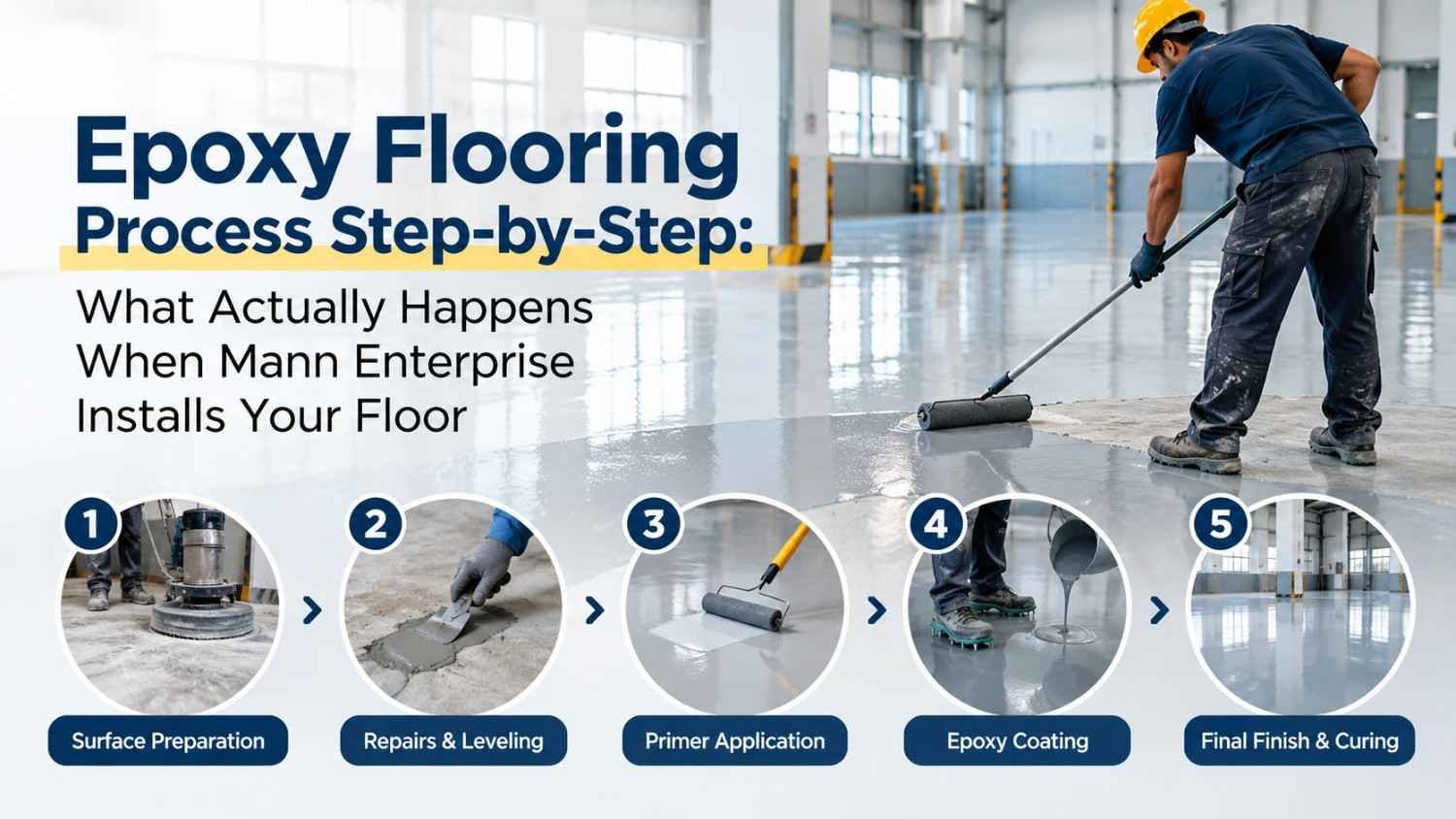
If you’re researching epoxy flooring in Ahmedabad, you’ve probably already seen dozens of contractors promising a “glossy, durable finish.” What most of them don’t show you is how that finish is actually achieved — and that’s exactly where floors succeed or fail.
At Mann Enterprise, with over 10 years of experience delivering industrial epoxy flooring in Ahmedabad, we’ve seen firsthand that almost every epoxy floor failure — peeling, bubbling, cracking, early wear — traces back to one thing: skipped or rushed preparation work. The epoxy coating itself is rarely the problem. The process behind it is.
This guide walks you through exactly what happens, step by step, when Mann Enterprise installs an epoxy floor — so you know what to expect, and what to ask any contractor you’re considering.
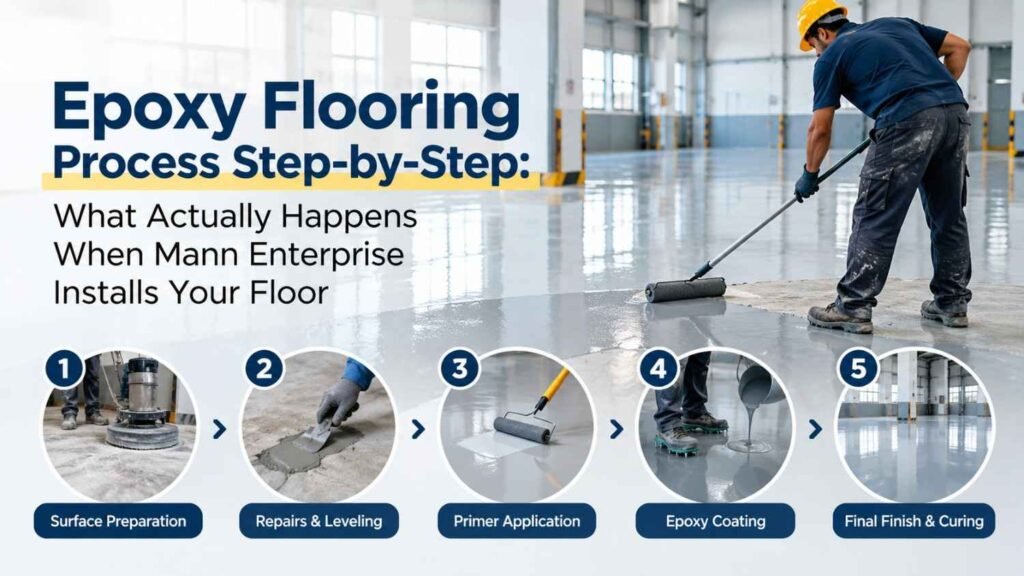
Step 1: Site Inspection & Floor Assessment
Before any material touches your floor, we carry out a free site visit to assess:
- The current condition of the concrete (cracks, moisture, previous coatings)
- The type of facility — warehouse, pharmaceutical unit, food & beverage plant, automobile workshop, or car parking
- Expected load (foot traffic, machinery, forklifts, chemical exposure)
- Moisture levels in the slab, which affect adhesion
This step decides everything that follows. A pharmaceutical cleanroom needs a different system than a warehouse floor handling forklift traffic, and a car parking structure needs different UV and abrasion resistance than an indoor factory floor. Industrial epoxy flooring in Ahmedabad isn’t one-size-fits-all, and any contractor who quotes you a price without visiting the site first is skipping this critical step.
Step 2: Surface Preparation (The Step Most Contractors Rush)
This is where floors are won or lost. Our team carries out:
- Diamond grinding or shot blasting to remove existing coatings, laitance, and contamination
- Crack repair and joint filling using appropriate epoxy fillers
- Moisture testing to confirm the slab is dry enough for coating
- Dust removal and surface cleaning to ensure a contamination-free base
Skipping proper grinding is the single biggest reason epoxy floors fail early — the coating simply doesn’t bond to the concrete underneath, leading to peeling and delamination within months. We treat this stage as non-negotiable, regardless of project timeline pressure.
Step 3: Priming
A high-quality primer is applied to:
- Seal the porous concrete surface
- Improve adhesion between the concrete and the epoxy topcoat
- Reduce the risk of bubbling caused by trapped air or moisture vapor
For larger industrial spaces, we allow adequate curing time here rather than rushing to the next coat — a shortcut that shows up as adhesion failure later.
Step 4: Repair & Leveling
Once primed, we address:
- Low spots and uneven areas using self-leveling epoxy compounds
- Expansion joints and control joints, sealed appropriately
- Any remaining surface imperfections
This creates the smooth, seamless base that epoxy flooring in Ahmedabad’s industrial and commercial spaces is known for — no seams for dust, bacteria, or chemicals to collect in.
Step 5: Epoxy Application (Base Coat + Top Coat)
Depending on the facility’s requirements, we apply the appropriate epoxy system:
- Self-leveling epoxy — smooth, glossy finish for pharma, cleanrooms, and showrooms
- Epoxy mortar systems — heavy-duty builds for warehouses and food processing units
- ESD/anti-static epoxy — for electronics, semiconductor, or explosion-sensitive environments
- Broadcast/flake systems — added slip resistance and durability for high-traffic zones
Each layer is applied at the correct thickness and allowed to cure under controlled conditions before the next coat goes on. Rushing cure times between coats is another common shortcut that leads to a soft, easily damaged final surface — something we avoid entirely.
Step 6: Top Sealant & Curing
A final protective topcoat is applied to enhance:
- Chemical and stain resistance
- UV stability (particularly important for car parking and outdoor-facing areas)
- Long-term gloss retention
The floor is then left to cure fully before it’s opened to foot traffic or machinery — walking on an under-cured epoxy floor is one of the most common causes of early surface damage.
Step 7: Final Inspection & Handover
Before handover, we walk the site with you to check:
- Finish consistency and gloss level
- Edge and corner detailing
- Overall adhesion and surface quality
We also share basic maintenance guidance so your floor performs for years, not months.
Why the Process Matters More Than the Product
Most flooring contractors in Ahmedabad will talk about the epoxy brand or the finish color. Very few will walk you through the preparation process — because it’s the less glamorous, more labor-intensive part of the job. But it’s also the part that determines whether your floor lasts 10+ years or starts failing within a year.
This is the standard Mann Enterprise applies across every project — whether it’s industrial epoxy flooring in Ahmedabad for a warehouse, a pharmaceutical cleanroom, an automobile workshop, or a multi-level car parking structure.
Frequently Asked Questions
How long does the epoxy flooring installation process take? Most industrial projects take 3–7 days depending on floor area, condition of the existing concrete, and the number of coats required. Larger warehouses or multi-stage projects may take longer.
Can epoxy flooring be installed over old, damaged concrete? Yes, provided the surface is properly ground, cracks are repaired, and moisture levels are within acceptable limits. This is assessed during the site inspection stage.
How soon can I use the floor after installation? Light foot traffic is usually possible within 24–48 hours, while full machinery or heavy load use typically requires 5–7 days of curing, depending on the epoxy system used.
Do you offer a free site visit before quoting? Yes. Mann Enterprise offers a free site inspection across Ahmedabad — including Kathwada, Naroda, Vatva, Odhav, and surrounding industrial areas — before providing a quote, so you know exactly what your floor needs.
Get a Free Site Visit from Mann Enterprise
If you’re planning epoxy flooring in Ahmedabad for your factory, warehouse, pharmaceutical facility, or commercial space, don’t settle for a contractor who skips the process that actually matters.
Mann Enterprise — 10+ years of industrial epoxy flooring and waterproofing expertise in Ahmedabad.
📍 Swetayan Industrial Park, Kathwada, Ahmedabad, Gujarat 📞 +91-8155986415 🌐 mannenterprise.com
Book your free site visit today.