
If you run a unit in a GIDC estate, you already know the floor is one of those things nobody thinks about until it starts costing money.
It begins small. A bit of dust on the machines. A crack near the loading bay. An oil patch that never quite comes out. Then one day a forklift tyre digs into a broken edge, a supervisor slips on a wet patch, and you are suddenly looking at repairs in the middle of a production week.
We have walked through a lot of factory floors across Ahmedabad’s industrial areas, and the pattern repeats. The problem is rarely “we picked epoxy and it failed.” It is usually “we picked the wrong system for the job, or the surface was not prepared properly.”
This guide is meant to help you avoid that. It is written for factory owners, plant managers and purchase heads who want a straight answer.
Why GIDC factory floors take such a beating
Industrial estates around Ahmedabad, such as Vatva, Naroda, Odhav, Kathwada, Sanand, Changodar and Bavla, house very different kinds of units, but their floors face a similar set of challenges:
- Heavy, constant movement. Pallet trucks, forklifts, trolleys and material handling run all day.
- Oil, grease and chemicals. Engineering, auto, plastics, chemical and dye units all see spills regularly.
- Dust. Bare or poorly finished concrete slowly breaks down and starts dusting, which settles on machines and products.
- Water and washdowns. Food, pharma and process areas are cleaned often, and monsoon moisture rises through slabs.
- Heat. Ahmedabad summers are hard on floors, especially in sheds with limited insulation.
- Tight schedules. Most owners cannot shut the plant down for weeks to fix a floor.
Plain concrete handles some of this for a while. Eventually it does not, and that is when a proper floor system starts to make financial sense.
Epoxy flooring in one minute
Epoxy flooring is a resin-based coating system applied over prepared concrete. When it is done well, you get a hard, seamless, chemical-resistant surface that is easy to clean and holds up under traffic far longer than bare concrete or basic paint.
But “epoxy” is not one product. It is a family of systems, and picking the wrong one is the most common reason people feel let down. So let us look at the options.
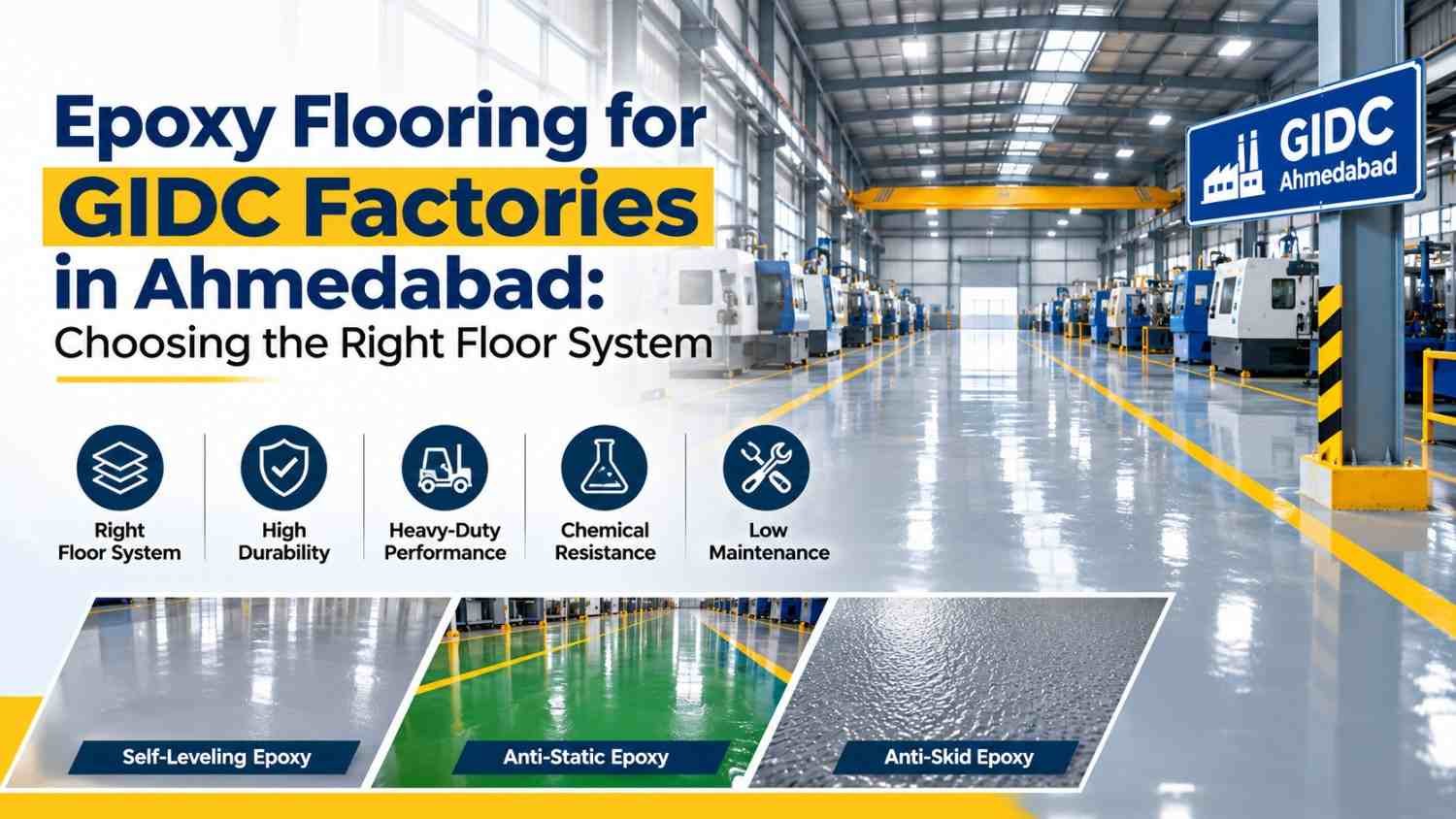
The main epoxy floor systems for factories
| System | What it is | Best for | Think twice if |
|---|---|---|---|
| Thin epoxy coating | A light protective coat over sound concrete | Low-traffic areas, offices, light storage | Heavy traffic, chemicals or impact |
| Self-leveling epoxy (typically 1 to 3 mm) | A flowing system that settles into a smooth, seamless surface | Production floors, pharma, food, packing, assembly, showrooms | Very heavy impact or point loads |
| Epoxy mortar / heavy-duty system | A thick, strong build with aggregates | Warehouses, loading bays, forklift lanes, heavy machinery zones | You need a very smooth, decorative look |
| Anti-slip / broadcast system | Epoxy with aggregate for grip | Wet areas, ramps, washdown zones, walkways | Strict smoothness or easy sweeping is the priority |
| ESD (anti-static) epoxy | Conductive or dissipative flooring | Electronics and static-sensitive work | Standard production with no static concerns |
| Chemical-resistant systems | Formulations for acids, alkalis and solvents | Chemical, dye, battery and process areas | General dry storage |
The honest takeaway: one factory often needs more than one system. A packing hall, a forklift corridor and a chemical dosing area should not all get the same floor.
Which floor system suits your type of factory?
Here is a practical starting point. Your own inspection will refine it.
Engineering and auto component units Mixed traffic, oil and coolant spills, and heavy machines. A durable self-leveling or epoxy mortar system with good chemical resistance usually works, with heavier build in forklift lanes.
Chemical, dye and process units (common in areas like Vatva) Spills of acids, alkalis and solvents are the main threat. The priority is a chemical-resistant system, proper containment areas and well-sealed joints. Not every epoxy resists every chemical, so the exact chemicals involved matter.
Pharmaceutical and cleanroom-type areas Seamless, hygienic, easy-to-sanitise surfaces are the goal. Self-leveling epoxy is a common choice. See our pharma epoxy flooring cost and case study for a 10,000 sq. ft. example.
Food and beverage units Frequent washing, moisture and temperature changes call for a seamless, non-porous, slip-aware floor with proper drainage detailing.
Plastics, packaging and light manufacturing Moderate traffic and a need for clean, dust-free surfaces. Self-leveling epoxy is usually a good fit.
Warehouses and logistics sheds Forklifts and heavy loads mean thicker, tougher systems and well-prepared joints. Line marking for lanes and safety zones adds a lot of value here.
Electronics and assembly Dust control and static control come first. ESD epoxy may be needed in specific zones.
Six questions to answer before choosing a system
Sit down with your maintenance head and answer these. They will make any contractor conversation much easier.
- What is the heaviest thing that moves across this floor? Pallet trolley, loaded forklift, or machinery on wheels?
- What spills on it? Name the actual chemicals, oils or liquids.
- How often is it washed? Daily washdowns need different detailing from occasional sweeping.
- How clean does it need to be? General industrial, food-grade or pharma-grade?
- What shape is the existing slab in? Cracks, damp patches, old coatings, uneven areas?
- How much downtime can you afford? One weekend, a few days, or phased area by area?
If a contractor does not ask you most of these, be a little careful.
The part nobody puts on the brochure: surface preparation
Here is what we tell every client. The epoxy itself is only half the job. The other half is the concrete underneath.
Most epoxy floors that peel, bubble or flake early failed because of what happened before the epoxy went down: grinding skipped, cracks left unrepaired, moisture ignored, dust not fully removed.
A proper job includes:
- Inspection of the slab and a moisture check
- Grinding or shot blasting to open up the surface and remove old coatings
- Crack and joint repair
- Thorough dust removal
- Priming
- The epoxy system at the agreed thickness
- Proper curing before traffic returns
You can read the full breakdown in our step-by-step epoxy flooring process guide.
Common mistakes we see in factory flooring projects
- Picking on price alone. The cheapest quote often means thin coverage or rushed preparation.
- Using one system everywhere. A forklift lane and a packing table do not need the same floor.
- Coating over damp concrete. Moisture in the slab is a quiet floor killer, especially after monsoon.
- Ignoring joints. Expansion and control joints need proper treatment, or cracks reappear along them.
- Opening the floor too soon. Curing time is not optional.
- Forgetting maintenance. Even a good floor needs the right cleaning routine.
How we handle downtime for working factories
A common worry we hear is, “We cannot stop production.” Fair enough. In many cases the work can be planned in phases, for example one bay at a time, over weekends or during shutdowns. During the site visit we look at your production flow and suggest a plan that disrupts you as little as possible. Whether it works depends on your layout, so we tell you honestly after seeing the site.
About Mann Enterprise
We are a Kathwada-based epoxy flooring and waterproofing team with over 10 years of experience working with factories, warehouses, pharma and food plants, car parkings and commercial spaces across Ahmedabad.
Our approach is simple. We visit your site first, check the floor, listen to how it is actually used, and then recommend a system and give you a written quote. If your floor only needs repair or a lighter solution, we will say so.
Explore our industrial epoxy flooring services in Ahmedabad or our terrace and industrial waterproofing services.
Areas we serve
We work across industrial estates and nearby areas in Ahmedabad, including Kathwada, Naroda, Vatva, Odhav, Sanand, Changodar and Bavla. If your unit is in another GIDC estate or nearby, call us and we will confirm whether we can cover it.
Frequently asked questions
Which epoxy flooring is best for GIDC factories in Ahmedabad? It depends on your use. Self-leveling epoxy suits many production and clean areas, epoxy mortar suits heavy forklift and impact zones, and chemical-resistant systems suit areas with acids, alkalis or solvents. A site inspection is the most reliable way to decide.
Can epoxy flooring be applied in an existing, running factory? Often yes. Work can usually be phased area by area or done during shutdowns to limit disruption. Your layout and production schedule decide what is practical.
How long does epoxy flooring last in a factory? With proper preparation, correct installation and reasonable maintenance, industrial epoxy floors can last many years. Traffic, chemical exposure and installation quality all affect lifespan.
Is epoxy flooring good for heavy forklift traffic? Yes, if the right heavy-duty system is chosen and the slab is properly prepared. Thin coatings are not suitable for heavy forklift lanes.
Does epoxy flooring resist chemicals? Many epoxy systems resist a wide range of chemicals, but not all resist every chemical. Tell your contractor exactly what is used on the floor so the right formulation is chosen.
How much does industrial epoxy flooring cost in Ahmedabad? Cost depends on the system, thickness, floor condition, area and preparation required. A free site visit gives you a realistic quote for your actual floor.
Does Mann Enterprise offer free site inspections for factories? Yes. We offer a free site inspection and a clear written quote across Ahmedabad.
Do you work in Vatva, Naroda, Odhav, Kathwada and Sanand? Yes. We regularly work across these and nearby industrial areas.
Book a free site visit
If you are planning flooring for a factory in a GIDC estate, we would be glad to take a look, with no pressure and no obligation. Tell us what the floor deals with every day, and we will suggest a system that fits.
Mann Enterprise Swetayan Industrial Park, Kathwada, Ahmedabad, Gujarat 382430 Phone: +91-8155986415 Website: mannenterprise.com